

Welcome to Thrive, a newsletter with information and tips about food, exercise, health and wellbeing.
WHAT DID YOU SAY???
Raise your hand if you called yourself an idiot/loser/worse for forgetting something or doing something wrong this week. Now, run through the incident again and imagine if this happened to your best friend. Would you say the same to them? Chances are you would choose your words carefully to protect their feelings. If we don’t think it’s ok to talk to others like this, why do we do it to ourselves?
What is self talk?
Self talk is our internal dialogue, our inner voice. It combines our stream of consciousness, our unconscious beliefs and biases. It can be positive (yeah!) or negative (boohoo).
Examples of positive self talk: “I can do this”, “I’m making progress”, or “I’m doing my best.”
Examples of negative self talk: “I can’t do anything right”, “I’m a failure”, or “I’m going to mess this up.”
There are four types of negative self talk:
- Personalising: You blame yourself for everything.
- Magnifying: You focus on the negative aspects of a situation, ignoring any and all of the positive.
- Catastrophosising: You expect the worst, and you rarely let logic or reason persuade you otherwise.
- Polarising: You see the world in black and white, or good and bad. There’s nothing in between and no middle ground for processing and categorising life events.
Why do we talk to ourselves negatively?
You might be a perfectionist or have high standards, or it could be down to a strict or rigid upbringing. You might have gone through a rough time which will bring a negative undertone to most aspects of your life.
Why does it matter?
Self-talk influences attitudes, feelings, self-image, and behaviour. Negative self talk can take a toll on someone’s confidence, fostering shame and limiting personal growth. The problem with negative self-talk is that it typically does not reflect reality, and so it can convince people, wrongly, that they are not only not good enough, but that they can never get better, paralysing them into self-absorption and inaction.
Self talk has been proven to significantly impact our self esteem, confidence and overall wellbeing which can then also impact our physical health. By choosing kinder words, you are more compassionate towards yourself, you manage stress better, increase self belief and confidence which leads to greater life satisfaction.
How to improve your self talk
Human nature is generally more pessimistic, and positive self-talk takes practice if it’s not your natural instinct. However you can learn to shift your inner dialogue to be more encouraging and uplifting and over time, your thoughts can become more positive:
Try the following techniques:
- Start by identify negative self talk – realising and acknowledging what we say is the first step.
- Imagine the same scenario with your best friend who is having a tough time. What would you have said to them?
- Use your name instead of “I” during moments of inner dialogue. Research has found that it can create useful psychological distance from the emotional intensity of the self, enabling the individual to avoid rumination and process with greater perspective, calm, and confidence.
- At the end of each day, think about something you did well to help your mind have a more positive outlook.
- Surround yourself with positive people.
Improving self talk takes time and effort but you will reap the benefits in all areas of your life. So take a step back, listen to your inner dialogue and treat yourself better ❤️.
Test yourself
How long can you stand on one leg, first with your eyes open and then closed? Why do you ask? Falls are the most common cause of accidental death after road traffic accidents, and unless you do something about it, your balance will deteriorate as you get older.
This challenge tests two key components: balance and proprioception (the body’s ability to sense its position in space without relying on visual cues). We use our eyes to keep us upright but once this is no longer available, we use our vestibular system (a spirit level in our inner ear). Having good balance is a powerful predictor of how long and how healthily you will live.
Start with one leg and your eyes open before doing the same with the other leg (which could be very different and need a little extra work!). Then try again, this time with your eyes closed. Here are the targets per age group:
- Under 40: 45 seconds with eyes open, 15 seconds with eyes closed.
- Aged 40-49: 42 seconds open, 13 seconds closed.
- Aged 50-59: 41 seconds open, 8 seconds closed.
- Aged 60-69: 32 seconds open, 4 seconds closed.
- Aged 70-79: 22 seconds open, 3 seconds closed.
Don’t despair if you didn’t do great on your first attempt. The good news is you can improve your balance with activities such as yoga, tai chi or strength training. You can even practise balancing on one leg while cooking or brushing your teeth.
Recipe
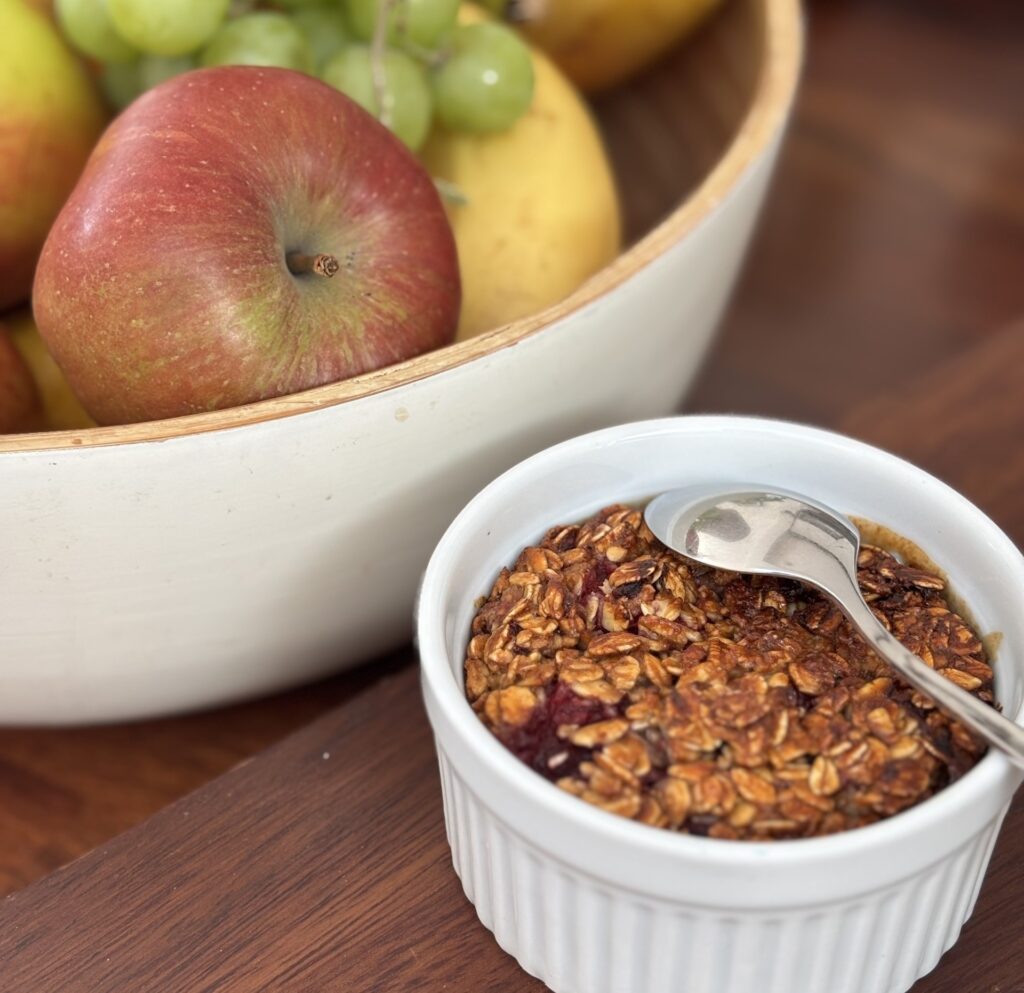
Fruity oat pots
I love making these little pots, either for breakfast or for dessert after a light meal. You can change fruit and add any toppings you like, depending on what you have at home and what you fancy!
For 4 ramekins:
- 125g rolled oats
- 125g fruit (I used frozen berries but could be grated apple or pear)
- 125g milk or milk substitute
- 2 eggs
- 1 tbsp honey
- 1 tsp baking powder
Mix all the ingredients in a bowl and pour evenly into four ramekins. Bake at 180 degrees Celsius for 20 minutes. Serve warm with Greek yogurt or yogurt substitute on the side. Enjoy!
Buzzword
Sleepmaxxing
Viral trend where individuals try to improve their sleep by using a variety of tools and techniques. While some of these can be part of a healthy sleep routine (no screen for an hour before bed, reading a book), others are questionable and can be downright harmful (mouth taping). Unfortunately the pressure to optimise sleep can be counterproductive and lead to increased stress and anxiety, as the more pressure we put ourselves under, the harder it can be to fall or stay asleep. The key thing to remember is that sleep hygiene is not a one size fits all. It may take time to see improvements but even the smallest of changes can make a real difference over time.
News
I am pleased to announce that I am starting day retreats from my home. Watch out for more info about topics covered and dates.